American Folk Art Museum Announces Exhibit Schedule Three Exhibitions Explore Artistic Self-Representation And Identity During Americas 250th Anniversary Year
January 16, 2026
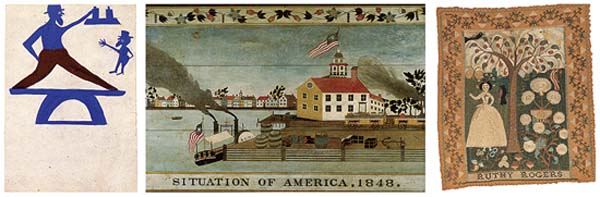
The American Folk Art Museum, the nations museum of folk and self-taught art, will present three original exhibitions in 2026. Addressing themes of artistic identity, agency, and national belonging, these projects reaffirm AFAMs commitment to exploring how creativity both reflects and shapes cultural experience. The upcoming presentations, Self-Made: A Century of Inventing Artists, Folk Nation: Crafting Patriotism in the United States, and Locating Girlhood: Place and Identity in Early American Schoolgirl Art, will be on view in the museums recently renovated galleries. Together, they engage timely questions of belonging, self-definition, and collective memory as the nation marks the 250th anniversary of its founding. Opening on April 10, 2026, Self-Made and Folk Nation will launch a spring season of dynamic programming. Locating Girlhood will follow in the autumn, opening on Oct. 8. Self-Made: A Century of Inventing Artists provides an innovative focus on artistic self-representations of the 20th century as well as contemporary works, addressing for the first time how formally untrained artists have identified, imagined, and depicted themselves as capital-A Artists. Examining methods of artistic self-fashioning, including self-portraiture, signature pieces, and depictions of alter egos, the exhibition takes a critical approach to the historical formulation of the self-taught artist in the United States, from the first half of the 20th century to present time. A tightly curated selection of 90 artworks, primarily drawn from the American Folk Art Museum collection, the exhibition includes photographs, artists notebooks and videos, as well as prime examples of drawings, paintings, and sculptures, many of them recent or rarely seen acquisitions. Works by John Kane, Morris Hirshfield, Martn Ramrez, Henry Darger, Sister Gertrude Morgan, Thornton Dial Sr., Joe Coleman, and Nicole Appel are placed in dialogue with pieces by seminal international artists such as Alose Corbaz, Madge Gill, Augustin Lesage, Adolf Wlfli, and Marcel Bascoulard. This presentation offers a rich survey of key figures and contributions against a backdrop of the most recent scholarship in this artistic area, with persuasive insights into artistic status, creative aspirations, intentions, and agency from this field-defining period. Self-Made will be curated by Valrie Rousseau, Ph.D., curatorial chair and senior curator of 20th-century and contemporary art, with the assistance of Suzie Oppenheimer, Ponsold-Motherwell curatorial fellow. The second exhibit, Folk Nation: Crafting Patriotism in the United States, mounted during the celebration of the United States semiquincentennial, draws from the American Folk Art Museums rich collections to explore links between vernacular art and the construction of an American sense of self. Introducing visitors to the concept of folk as a category developed in conjunction with the art and antiques markets, this exhibition positions works as multilayered in their meanings, imbued with cultural significance by not only their creators, but also their collectors and subsequent owners. Americans have long preserved objects as a way of telling stories about themselves. Beginning after the Revolutionary War and gathering momentum in the late 19th and early 20th centuries, people turned to early American things to construct a national history and sense of collective identity, an impulse often driven by lingering insecurity about the young nations perceived cultural provinciality compared to Europe. This concentrated exhibition illuminates how makers both historical and contemporary have employed a kaleidoscopic variety of media to express love of country while also revealing the complexities and contradictions embedded in such expressions. Folk Nation will be curated by Emelie Gevalt, Ph.D., Deborah Davenport and Stewart Stender deputy director and chief curatorial and program officer, and Caroline Culp, Ph.D., Warren Family assistant curator. It will be presented in the Audrey B. Heckler Gallery. Locating Girlhood: Place and Identity in Early American Schoolgirl Art will feature spectacular examples of needlework and other ornamental arts made by American girls in the 18th and 19th centuries. It aims to shed new light on a rich but understudied genre, offering one of the most significant presentations on the subject in recent memory. This major loan exhibition brings together approximately 100 exceptional objects from over 35 museums and private collections nationwide, uniting celebrated masterpieces with remarkable lesser-known gems rarely seen by the public. Unlike many earlier exhibitions, Locating Girlhood explores girlhood artworks from an explicitly art historical perspective, reframing these objects through the lens of place. Though the story of landscape art in the United States has traditionally centered on male academic painters, American girls and young women were laboring over a variety of landscape scenes long before the Hudson River School. From the 18th century onwards, representations of landscape were a common visual thread in samplers, needlework pictures, watercolors, and other artworks commonly united under the umbrella term schoolgirl art, extending from country scenes and cityscapes to maps and other cartographic compositions. By considering these works as deeply resonant expressions of place, the exhibition expands the story of the American landscape and situates women at its heart. Timed to coincide with the USs semiquincentennial, Locating Girlhood both celebrates the creativity of early American girls and women and critically examines the Colonial and early federal ideologies that structured their worldview. Locating Girlhood will be curated by Emelie Gevalt, Ph.D., Deborah Davenport and Stewart Stender deputy director and chief curatorial and program officer, and Caroline Culp, Ph.D., Warren Family assistant curator. To learn more, visit www.folkartmuseum.org.
Share & Print






SHARE
PRINT