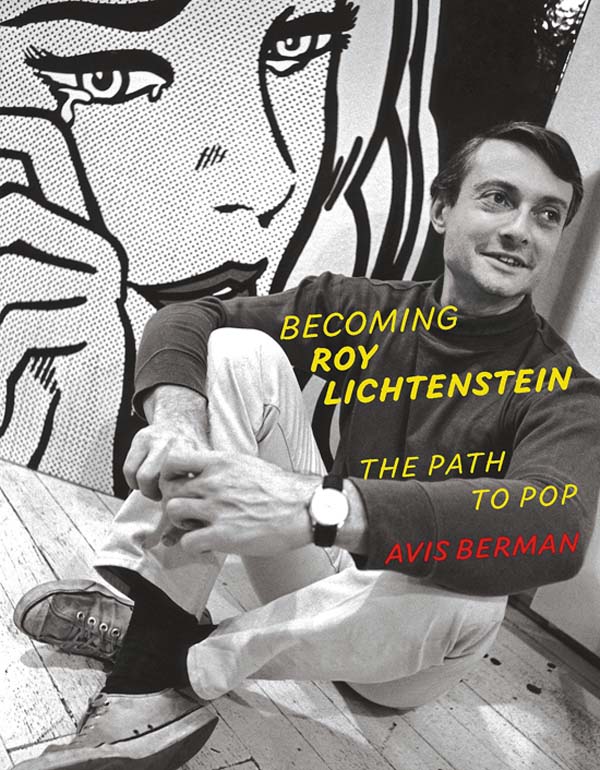
Becoming Roy Lichtenstein: The Path To Pop
New Book Tells Story Of Famous Pop Artist
By Karl Pass - November 20, 2026
Before Roy Lichtenstein became one of the most recognizable artists of the 20th century, he was a struggling painter and Rutgers professor who had spent nearly two decades trying to find his artistic voice.
“In Becoming Roy Lichtenstein: The Path to Pop” (Abbeville Press), art historian Avis Berman tells the story of Lichtenstein's life leading up to his 1961 breakthrough, when he painted “Look Mickey” and changed the course of American art.
Drawing on hundreds of interviews and extensive archival research, including oral histories Berman began compiling for the Roy Lichtenstein Foundation in 2001, the biography reveals the personal struggles and artistic influences that shaped the man behind the iconic paintings.
When Roy Lichtenstein painted his canvas “Look Mickey,” an image of Donald Duck and Mickey Mouse adapted from a storybook belonging to his young sons, he was an obscure 37-year-old assistant professor at Rutgers who had labored for years on the periphery of the art world. Within a few years, Pop paintings like this one, in which he transformed the crude imagery and graphic techniques of the funny pages into carefully ordered compositions, would make Lichtenstein rich and famous like few artists before. His art, instantly recognizable yet cool and impersonal, had the curious effect of obscuring its own history and the man behind it. But who was Roy Lichtenstein? And how had he, at the moment of painting “Look Mickey,” finally been able to transcend the boundaries of his own good taste and elevate comics to high art?
Now, for the first time, the story of Lichtenstein’s life up through his annus mirabilis is told in full. Author Avis Berman, drawing on interviews with the artist’s friends, relatives, students, and colleagues, as well as extensive archival research, takes us from his childhood on the Upper West Side to his education at Ohio State, where a charismatic mentor teaches him “how to see,” his tumultuous first marriage and peripatetic teaching career, his struggle to find his own style and escape the shadow of Abstract Expressionism, and finally the fateful summer of 1961. It is an unexpectedly moving story, one that brings Lichtenstein to life as an American master to stand beside a Warhol, a Pollock, a de Kooning, an O’Keeffe.
Avis Berman has written extensively on art for publications including the New York Times, the Washington Post, and the Boston Globe. Her books include “Rebels on Eighth Street: Juliana Force and the Whitney Museum of American Art;” “Edward Hopper’s New York;” and “Roy Lichtenstein: The Impossible Collection.” She is also an oral historian of art, having interviewed more than 500 artists, curators, critics, dealers, collectors, and other art world figures for such organizations as the Archives of American Art, the Metropolitan Museum of Art, and the Museum of Modern Art. The oral histories she compiled for the Roy Lichtenstein Foundation, starting in 2001, were the genesis of this book.
To learn more, visit Abbeville Press at www.abbeville.com.
Share & Print






SHARE
PRINT