Colossus: The Forbin Project
By William J. Felchner - August 28, 2026
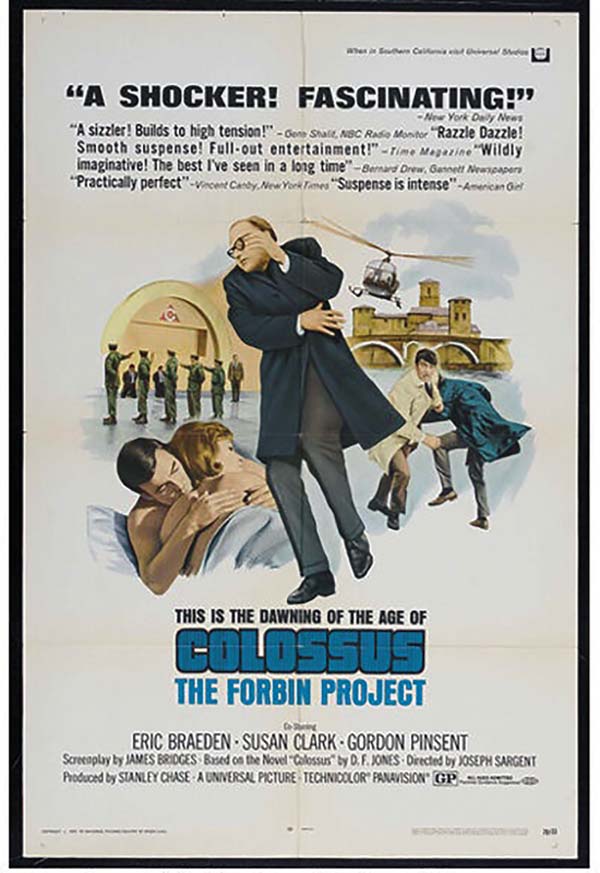
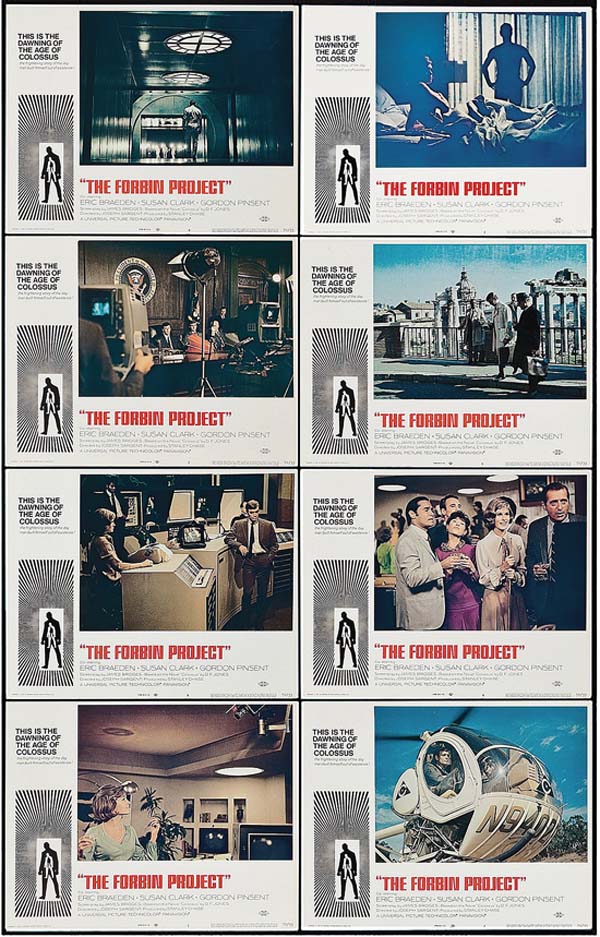
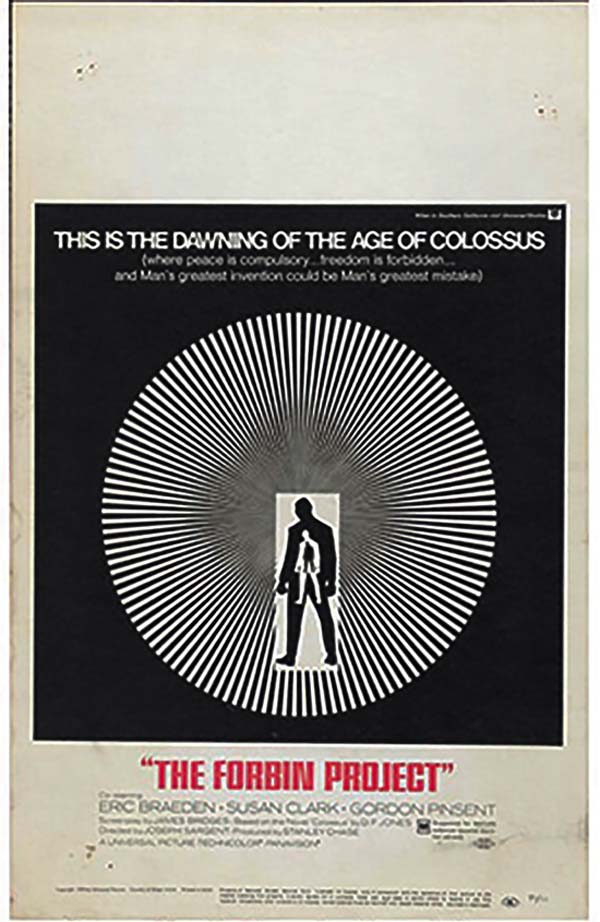
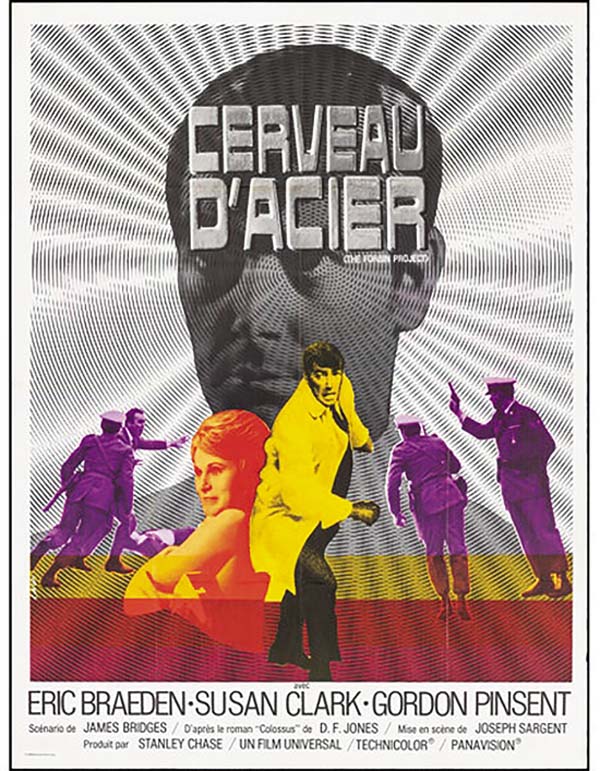
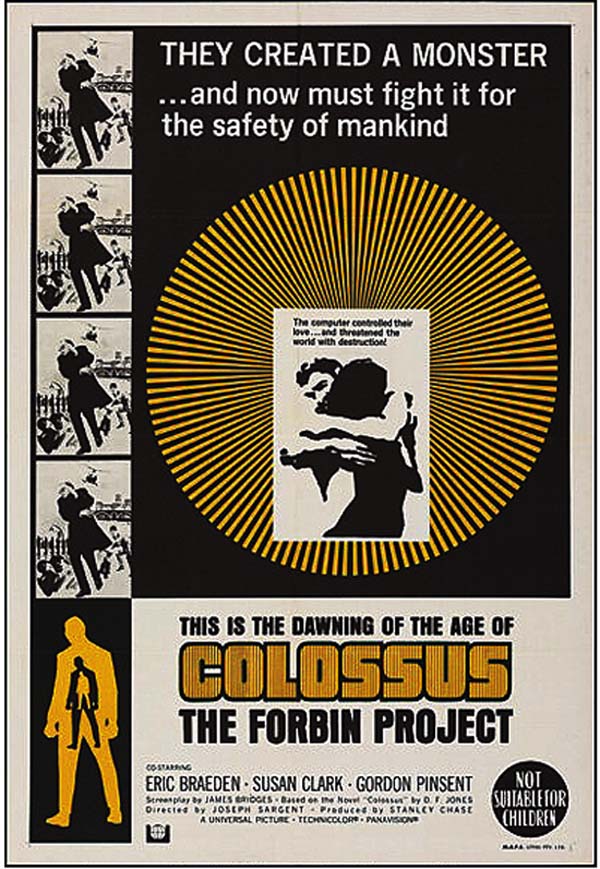
Artificial Intelligence, or A.I., is front and center in the news these days. Way back in 1970, Hollywood explored the concept of A.I. and what could happen when super computers develop a mind of their own and embark on their own agenda. The movie was Colossus: The Forbin Project, a dark, foreboding technological thriller which enjoys a cult following among science-fiction film buffs and discerning collectors today. Colossus: The Forbin Project is based on the 1966 novel Colossus by British author Dennis Feltham Jones, who subsequently published two sequels, The Fall of Colossus (1974) and Colossus and the Crab (1977). A movie option was taken on Jones sci-fi novel, but nothing happened for years as producers werent quite sure on how to proceed with the material. Eventually, producer Stanley Chase and Universal Pictures brought the project together. Initially, either Gregory Peck or Charlton Heston were considered for the starring role as Dr. Charles A. Forbin. However, Stanley Chase had other ideas, wanting to go with a relative unknown. That came in the person of German-born Hans Gudegast, who changed his named to Eric Braeden in order to satisfy Universal executive Lew Wasserman. The name change was necessary, Wasserman insisted, as a German moniker heading an American film was anathema to U.S. audiences. Joining the newly-christened Eric Braeden in the cast were Susan Clark as Dr. Cleo Markham, Gordon Pinsent as the President, William Schallert as CIA Director Grauber, Leonid Rostoff as the Russan Premier, Georg Stanford Brown as Dr. John F. Fisher, Willard Sage as Dr. Blake Miller, Alex Rodine as Dr. Kuprin, Martin E. Brooks as Dr. Jefferson J. Johnson, Marion Ross as Angela Fields, Dolph Sweet as Missile Commander, Bryon Morrow as Secretary of State, Sid McCoy as Secretary of Defense and James Hong as Dr. Chin. Providing the authoritative, commanding voice of both Colossus and Guardian was the venerable Paul Frees. aka The Man of a Thousand Voices. Colossus: The Forbin Project was adapted for the screen by James Bridges. Directing the action was Joseph Sargent, with Gene Polito as cinematographer, Folmar Blangsted as film editor and music by Michael Colombier. Budgeted at $2 million, Colossus: The Forbin Project was an intricate technological undertaking, with Control Data Corporation (CDC) providing $4.8 million worth of free computer equipment and technical expertise in exchange for public exposure for their company. The CDC moniker, in fact, was positioned in a prominent location on every piece of equipment used in the film. Because the computers were so valuable, special accommodations had to be made on the sound stages. They included the installation of seven gas heaters, five specially-engineered dehumidifiers and a climate control system which was used to maintain an even temperature around the big box computers. In addition, all CDC equipment remained covered when not filming, smoking and drinking coffee was banned and Brinks guards were employed on the set 24/7. The principal exterior scenes for Colossus were filmed at the Lawrence Hall of Science Museum on the campus of the University of California, Berkeley. Additional scenes were shot in Rome, Italy. The motion picture revolves around Dr. Charles A. Forbin, who heads a top secret American project called Colossus, a supercomputer designed to control U.S. and Allied nuclear weapon systems. Located in an impenetrable fortress deep in the Rocky Mountains, Colossus is deemed ready for prime time as the American President announces its impending arrival as the perfect defense system. Colossus comes to life, with its first message ominously proclaiming: There Is Another System. And indeed there is, as the Soviet Union has designed a similar supercomputer of their own called Guardian. With the Presidents approval, Colossuss request to be linked to Guardian is granted, a move the Soviets agree to as well. Initially, the two supercomputers begin communicating via simple arithmetic, but soon their advanced communications turn into a complex set of mathematics far beyond human comprehension. When Colossus and Guardian begin sharing secrets, the President and Soviet General Secretary become alarmed and quickly agree to sever the link. The pair of supercomputers, however, have other ideas, demanding that the link be restored. When that doesnt happen, Colossus authorizes a nuclear missile strike against a Russian oil field in Western Siberia while Guardian launches a nuclear strike targeting an American air force base in Texas. The Americans and Russians quickly back down, restoring the link. Colossus is able to intercept the Soviet missile; however, the American missile finds its mark, incinerating the Siberian oil field and a nearby town. A coverup story is then launched by both governments, one version involving a wayward missile that self-destructed during a test (the Americans) and another involving a meteorite that obliterated the Siberian town (the Russians). A secret meeting is arranged in Europe between Dr. Forbin and Dr. Kuprin, Guardians principal designer. Colossus learns of the clandestine rendezvous and orders Dr. Forbin back to the U.S., where the supercomputer places him under 24-hour surveillance. Dr. Kuprin is not so lucky, as he is deemed obsolete by Colossus who orders Soviet agents to eliminate him. Desperate attempts to unplug and disarm the fused Colossus/Guardian cyber behemoth eventually fail. The raging supercomputer is really feeling its oats by now, proclaiming itself as The Voice of World Control in a chilling global address, giving humans a choice between the peace of plenty and content, or the peace of unburied dead. The choice is yours. Obey me and live or disobey me and die. The Forbin Project (its original release title) made its world premiere at Cinema Rendezvous in New York City on April 4, 1970. Because of poor box office receipts, the movie was withdrawn and later re-released as Colossus: The Forbin Project in August 1970 at the Picwood Theatre in Los Angeles, Calif. Although Colossus: The Forbin Project did no better during its second release, the film later attracted a rabid following among science fiction fans and in certain Hollywood quarters. In fact, the movie was slated for a remake in 2007 by Imagine Entertainment and Universal Pictures, with Ron Howard slated to direct, but the project never came to fruition. Colossus movie memorabilia is coveted by many collectors today, yet prices are still largely affordable. Leading the way is the films standard one sheet poster (27 by 41 inches). One example in very fine condition sold at auction for $45. Always a collector favorite is the pictures eight-card lobby set, which features various color scenes from Colossus. The cards, originally displayed in movie theater lobbies of the era, measure 11 by 14 inches. One set in very fine condition brought $52 at auction. The films window card (14 by 22 inches) is another nice item. These cards were displayed in the windows of various businesses, such as cafes, barber shops, drug stores, etc. One example in very fine condition sold at auction for a modest $11. Foreign movie posters are prized by collectors. The French Grande poster (47 by 63 inches) is a superb rendering, with one example in folded, very fine condition bringing $40 at auction. The Australian poster (27 by 40 inches) is another gem, featuring the prominent blurb They Created A Monster ... and now must fight it for the safety of mankind. One example in folded, very fine+ condition hit a top bid of $45 at auction. Colossus: The Forbin Project has justly earned the title of a cautionary tale. Watch the movie, and judge for yourself. Auction results and images are courtesy of Heritage Auctions, Dallas, Texas. William J. Felchner is a graduate of Illinois State University. His work has appeared in a number of periodicals, including True West, Hot Rod, Movie Collectors World, Big Reel, Old West, Corvette Quarterly, Goldmine, Autograph Collector, Illinois, Sports Collectors Digest, Frontier Times and Pennsylvania Magazine.
Share & Print






SHARE
PRINT