Late Medieval European Blockbooks
October 16, 2026
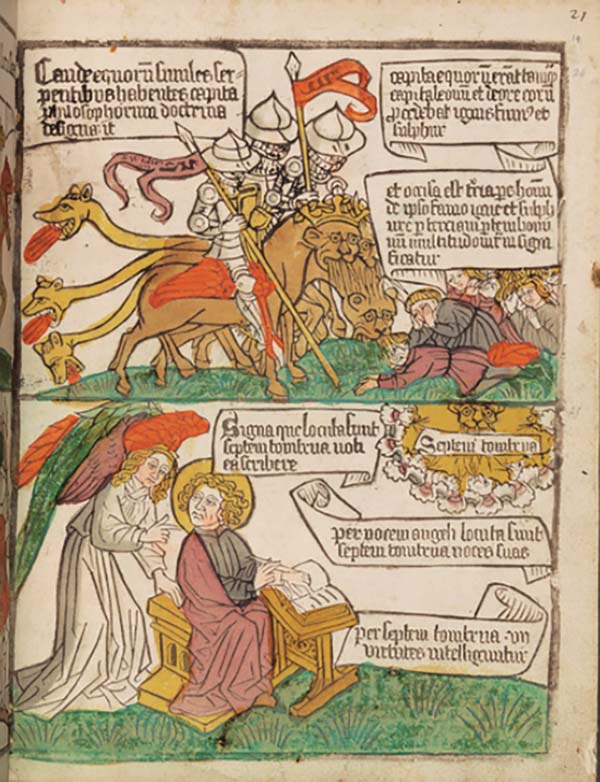
The Morgan Library & Museum will present Graphic Devotions: Late Medieval European Blockbooks, an exhibition that explores a pivotal 30-year period in European book history, from 1450 to 1480, when growing demand for books spurred innovation and experimentation in their production. Featuring 20 bound works plus five prints, the exhibition is the first in the United States devoted exclusively to blockbooks. It will be on view from Friday, Nov. 6, through May 16, 2027. Blockbooks, sometimes described as medieval graphic novels, are highly illustrated books printed entirely from woodblocks, with both text and images carved into the same blocks. While some blockbooks adapted texts and imagery from contemporary manuscripts, block cutters and printers generally created new texts specifically suited to the medium, allowing words and images to work together in an innovative and accessible format. First produced in the Low Countries and the Lower Rhine region in the mid-1450s and 1460s, blockbooks gained popularity in southern Germany from the 1460s until 1480. Although the woodcuts can appear comparatively simple or stylized by modern standards, the concept of creating books from ready-made woodblocks was revolutionary in Europe. In a sense, these blocks enabled an early form of print on demand. Once the text and images had been carved, copies could be produced as needed, offering a new way to reproduce books for a growing audience. Although woodblock printing had long been practiced in Asia, its use for books in Europe represented a significant development in the history of the medium. Ultimately, the labor-intensive process of printing books from woodblocks was surpassed by the efficiencies and capabilities of typographic printing, and the blockbook tradition largely disappeared by 1480. As a result, surviving examples are exceedingly rare. Their brief history represents a pivotal transitional moment in European book culture, bridging the traditions of handmade manuscripts and the emerging world of printed books. The Morgan holds the largest collection of blockbooks in the United States, with 20 examples ranging from complete copies to fragmentary copies and individual leaves. The exhibition will include eight blockbooks and five medieval manuscripts from the Morgans collection, as well as loans of blockbooks from the Library of Congress and the National Gallery of Art, Washington, D.C. As home to an unparalleled collection of blockbooks, the Morgan is uniquely suited to present the first exhibition of its kind in this country, said Colin B. Bailey, Katharine J. Rayner director of the Morgan Library and Museum. These extraordinary objects offer a unique window into the values, ideas, and artistic practices of late medieval European society, while revealing a critical moment of innovation in the evolution of the book. Typically religious in nature, these works include individual books of the Bible, theological visualizations of the Old and New Testaments, and devotional texts. Viewed in their historical context, these rare objects offer a broader perspective on the evolution of media and communication. Visitors to the exhibition will gain an understanding of blockbooks not just as aesthetic objects but also as windows into the histories of storytelling, bookmaking, and print production. For more information, call 212-685-0008 or visit www.themorgan.org.
Share & Print






SHARE
PRINT