Milestones Premier Military And Edged Weapons Sale
Top Lots Included Historic Revolutionary War Minuteman’s Silver-Hilted Sword
November 06, 2026
Milestone Auctions’ Sept. 26 Premier Military and Edged Weapons Auction closed the books at a robust $900,000, with well-provenanced antique and vintage items from across a 250-year timeline finishing at the top of prices realized.
After the auction concluded, Milestone’s co-owner and principal auctioneer Miles King remarked that the selection had been carefully curated by his team of experts to make sure historically significant items were within reach of both advanced and beginning collectors. “There were Revolutionary War and Civil War items that any American history museum would be thrilled to add to their collection. Additionally, we created large sections devoted to WWII, Nazi and Axis relics, including important uniform groupings, helmets and headgear, flags, medals, and an outstanding array of military swords, knives, daggers and katanas. Because there was such a variety of price points in the sale, literally every collector had the opportunity to bid on something special for their collection.”
The American Revolution came to life in the form of a silver-hilted Revolutionary War sword that was carried by Captain Isaac Hall, leader of the “Medford Minutemen,” on his march to Lexington, Mass. It was there at Lexington that Hall entered the 37th Massachusetts Infantry Regiment, an outfit that sustained heavy casualties during the war. In 1775, Hall organized another unit from Medford that included patriots from surrounding towns. In 1776, they proceeded to Dorchester Heights, a crucial site where the Continental Army, under George Washington, forced the British to retreat and evacuate Boston, marking a significant turning point in the conflict. The auction sword, 37 inches long with its original wire-wrapped bone grip, was given to Hall by John Fulton, a member of the Sons of Liberty and a participant in the Boston Tea Party. The weapon was first discovered in the attic of Hall’s 1720 house, which was the first stop on Paul Revere’s midnight ride and subsequently listed on the National Register of Historic Places. A unique witness to the Revolutionary War, Hall’s sword sold for $5,166 against an estimate of $1,500 to $2,500.
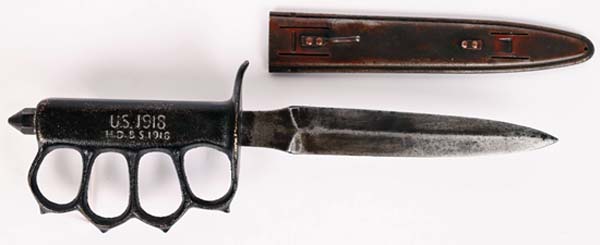
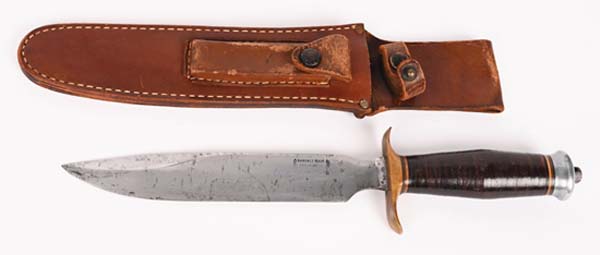
A fearsome WWI U.S. Model 1918 "knuckle duster" trench knife with spiked knuckle-guards, a “skull-crusher” pike pommel and solid-brass handle was made by Henry Disston & Sons (Philadelphia) and marked H. D. & S. on its handle. Disston is universally regarded as having been the greatest and most influential hand-saw manufacturer in American history, and for more than a century, their saws set the global standard for cutting performance, steel quality and craftsmanship. With credentials like that, it was only natural that they should have been called upon to produce a trench knife that “doughboys” could absolutely rely on. Housed in a scabbard marked L.F. & C. 1918, the auction example presented in excellent condition and was bid to $5,289 against a presale estimate of $2,500 to $3,500.
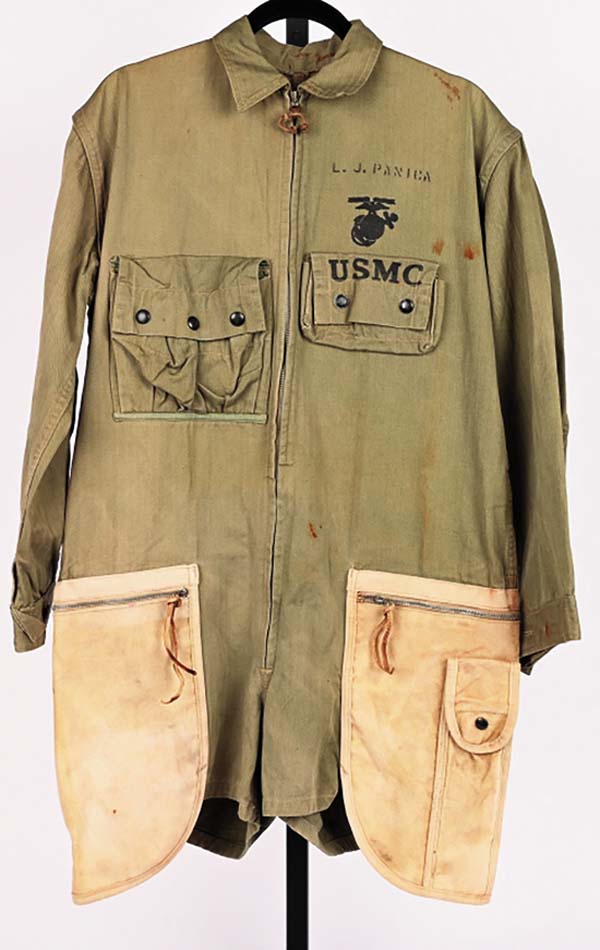
Many auction entries served as a testament to the extraordinary courage of U.S. troops during WWII. An authentic, ultra-rare, one-of-a-kind WWII U.S. Marine Corps Paramarine jump smock jacket bore similarities to the design of early German paratroopers’ smocks. A step-in style 1st Type, it had an exposed full-frontal zipper and two large exterior pockets. EGA and USMC were stenciled in black on the chest. It was also name-stenciled for (Sergeant) L. J. Panica, who was attached to the 28th Marines, 5th Division after the dissolution of the Paramarines. The well-documented smock jacket landed within its estimate range for $5,658. A WWII U.S. Army 60th Infantry Regiment M1 combat helmet was painted on both its sides with the legendary unit’s “Go Devils” insignia, a logo that originated in 1942. The helmet’s liner, produced by Mine Safety Appliance, also bore the legendary unit’s insignia. Signs of legitimate combat and field use added tremendous character and presence to the helmet, which nearly doubled its high estimate with a winning bid of $4,920.
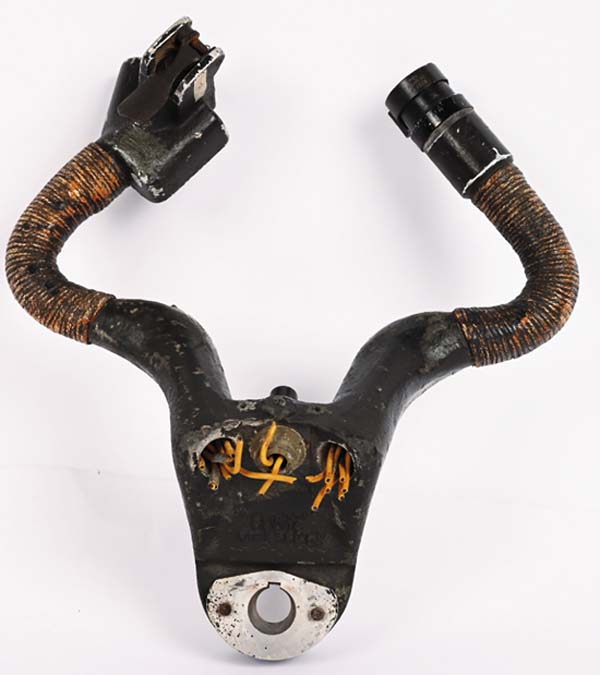
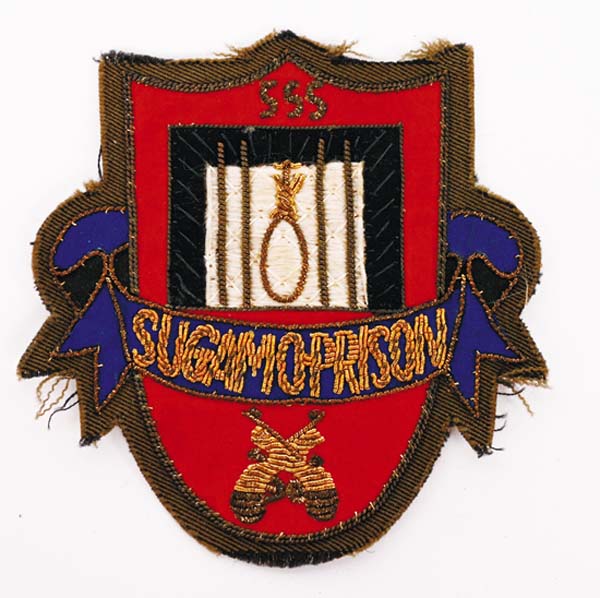
Axis highlights included a very rare German Luftwaffe steuerhorn (contro 1 yoke/grip) of a type used only on the Junkers Ju88 bomber, a twin-engine multi-role combat plane employed extensively during WWII and regarded as one of the most versatile aircraft of the conflict. “The Junkers Ju88 served as a bomber, dive bomber, torpedo bomber, night fighter, reconnaissance aircraft, and heavy fighter,” noted King. In excellent condition with clear tagging, the yoke sold for $7,072 against an estimate of $2,000 to $3,000. Very rare by any military collector’s standards, a WWII shoulder sleeve patch with insignia from 555 MP Co., Sugamo Prison in Japan bore the grim image of a hangman's noose stitched in bullion thread with 555 at the top and crossed pistols at the bottom. Sugamo Prison was built in 1895, using European prisons as its model. By the 1930s it became known for housing political prisoners, including many Communists and other dissenters who ran afoul of the Peace Preservation Laws in the 1930s and 1940s. Allied spies, captured officers and airmen were also incarcerated there during WWII. Sourced from an American war veteran, the patch sold above its estimate range, for $3,600.
All prices quoted in the report are inclusive of buyer’s premium as outlined on Milestone Auctions’ website, www.milestoneauctions.com.
All images courtesy of Milestone Auctions.

Share & Print






SHARE
PRINT