Newly Restored Portrait On View For First Time
Captain White Matlack Jr. Can Now Be Seen At Philadelphia’s Independence Seaport Museum
November 27, 2026
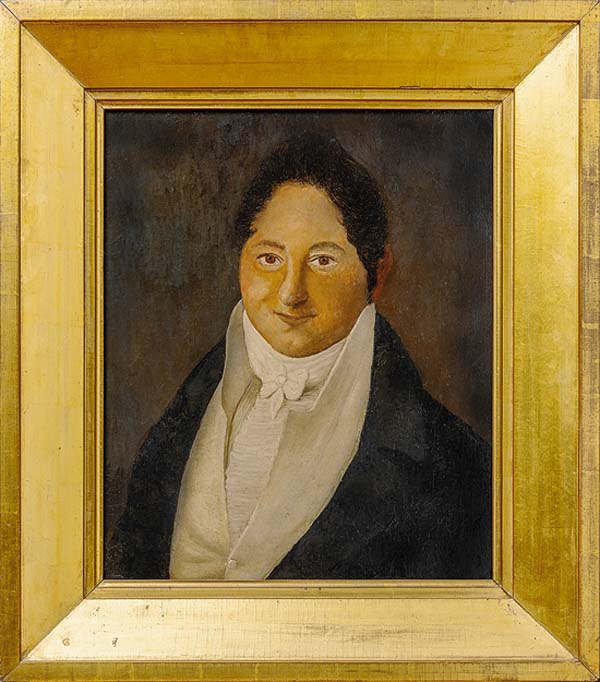
Through a generous Historic Preservation Grant from the National Society Daughters of the American Revolution (DAR) and the Independence Hall Chapter, a portrait that has been in Independence Seaport Museum (ISM)’s collection for decades but has never before been exhibited will go on view on Friday, Nov. 20.
It will join the museum’s landmark exhibition, “Seeking Profit and Power: Philadelphia, China Trade, and the Making of America,” which opened earlier this year. The portrait of Captain White Matlack, Jr. (1778-1833) and his story is representative of the years of upheaval and change that immediately followed the Revolutionary War as America developed its national identity and established itself in trade independent of the British crown. It also demonstrates some of the challenges faced by captains and merchants, proving that not every story was a successful one.
“We are so appreciative of the DAR’s support to restore this important painting in our collection,” said Peter S. Seibert, president and CEO of ISM. “The work, which has been in storage since it was first given to the museum, will now be exhibited to the public for the first time!”
The oil-on-canvas portrait was made by an unidentified artist, ca. 1809, in the folk-art style. The original sketch was said to be done in Portugal, but it is unclear if it was painted in the moment there or if it was done back in the United States. In a handwritten note associated with the portrait, it states: “While Capt. Matlack was waiting for his ship to be loaded he stopped frequently on his way to and from (the) docks to look at some very interesting picture in the windows of a print shop. The sketch for this portrait was made by an artist who was employed in the ship. He called Capt. Matlack into show him the sketch and (in) that way, he was persuaded to sit for his portrait.”
Captain Matlack’s portrait restoration addressed two main issues: removing the heavy varnish that lay atop the painting as well as correcting poorly executed inpainting that had been done prior to the painting being given to ISM. (Inpainting is a restoration technique in which a conservation professional retouches damaged areas of the painting that has removed layers of original paint; it must be completed sparingly to avoid altering the work of art.) In the case of this portrait, the inpainting was too heavily done, which resulted in the original artist’s intention being lost and the captain’s face developing a flat, smoothed-out appearance. Baumgartner Fine Art Restoration completed this work with fully reversable techniques as well as stabilizing the overall paint for ISM.
Captain White Matlack Jr. was born in Philadelphia on Feb. 16, 1778, as one of 13 children to White Matlack Sr. (1745-1824) and Mary (Hawkshurst) Matlack (1747-1825). When Matlack Jr. was about seven years old, the family left their Quaker meeting because of his father’s support for the American Revolution, in which he served as a minuteman. As a teenager, Matlack Jr. sought to be a sailor and quickly learned the trade, becoming a captain at the age of 21, and ultimately becoming an expert navigator and commander. He also became a successful merchant who operated ships that went around the world and oversaw the construction of new trade ships. In a July 4, 1813, letter to Jacob Barker, Esquire, it explained that Captain Matlack had been captured by the British Brig of War Sophie and was brought to Bermuda. Eventually, Matlack was released, and he owned and captained several ships. In 1816, he took ill with inflammatory rheumatism while sailing aboard the Carolina Ann. His wife, Abigail, along with their surviving son and daughter (three other children had died in infancy), were with him on that voyage. According to his daughter, Matlack’s son took observations for his father, and the calculations and daily reckoning were done by Captain Matlack from his sick bed.
Later that year, Matlack’s business took him and his family to Liverpool, England, where he began to build American-style ships for Copper & Benson, an English trading corporation. (At the time, this style of ships was quicker and lighter than those common in England.) As the first ship neared completion, Matlack received an order from the Board of Admiralty that forbade the vessel from leaving the Port of Liverpool: no ship built, owned, or commanded by an American was to be permitted to sail under the English flag or to leave an English port. Matlack was given a choice to either renounce his citizenship and swear loyalty to the Crown, or abandon his venture and return to the United States. He chose the latter and lost the entirety of his investment, which included several years of savings. This decision affected his financial future permanently. Eventually, Matlack retired in the United States in 1827 in ill health having never recovered his losses with little to leave his family.
With the addition of Captain White Matlack Jr. to “Seeking Profit and Power,” yet another story of a Philadelphian engaging in the risky independent trade as America found its footing on the world stage is revealed. Along with other recent acquisitions that have joined the exhibition in the past several weeks, there is much to explore both for new and returning visitors to “Seeking Profit and Power.”
The Independence Seaport Museum (ISM), founded in 1960 as the Philadelphia Maritime Museum, encourages visitors to discover the history of the Philadelphia region through the lens of the Delaware River. Steward of the Olympia, a 19th-century cruiser, and the Becuna, a WWII era submarine, ISM is home to interactive and award-winning exhibitions, one of the largest collections of historic maritime artifacts in the world and a boatbuilding workshop. Accredited by the American Association of Museums since the 1970s, it is a premier, seasonal destination adjacent to Spruce Street Harbor Park on Penn’s Landing. Visit www.phillyseaport.org/admissons-hours-of-operation/ to learn about current hours of operation, ticket packages, and guided tour options. See a full schedule of programs and events at www.phillyseaport.org.
Share & Print






SHARE
PRINT