
The Singer Family Pottery of Haycock Township, Bucks County, Pa. A Brief Examination Of Simon Singers Slip-Script Redware
By Justin W. Thomas - October 10, 2025
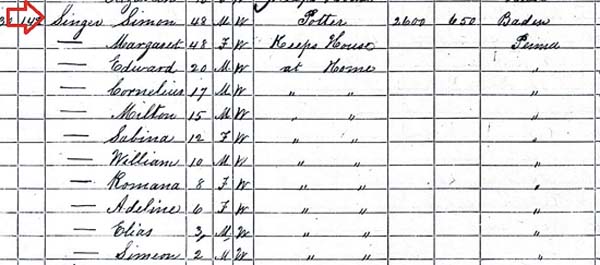
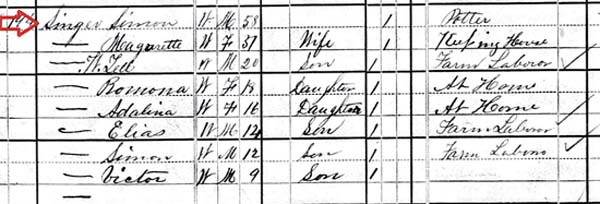
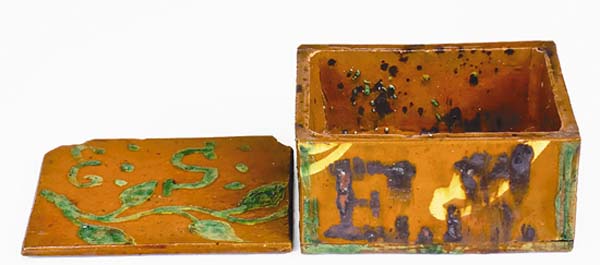
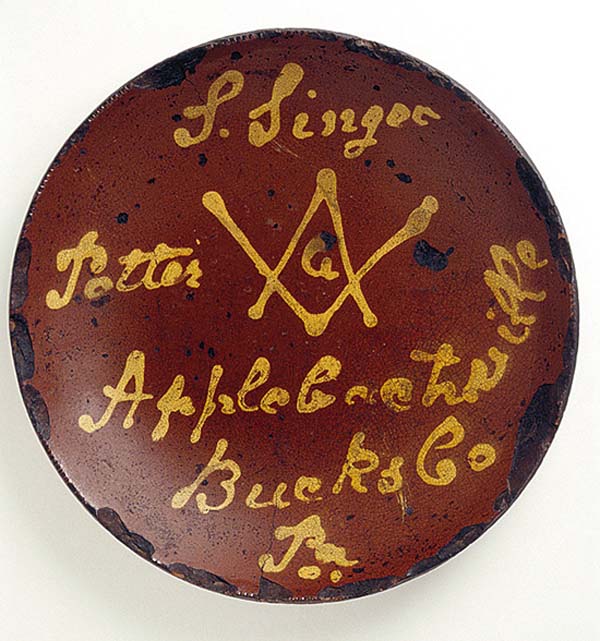
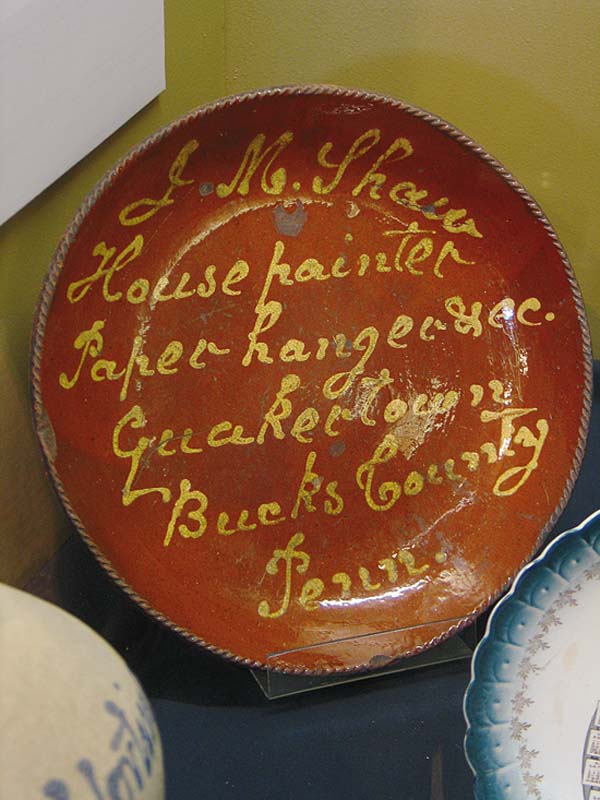
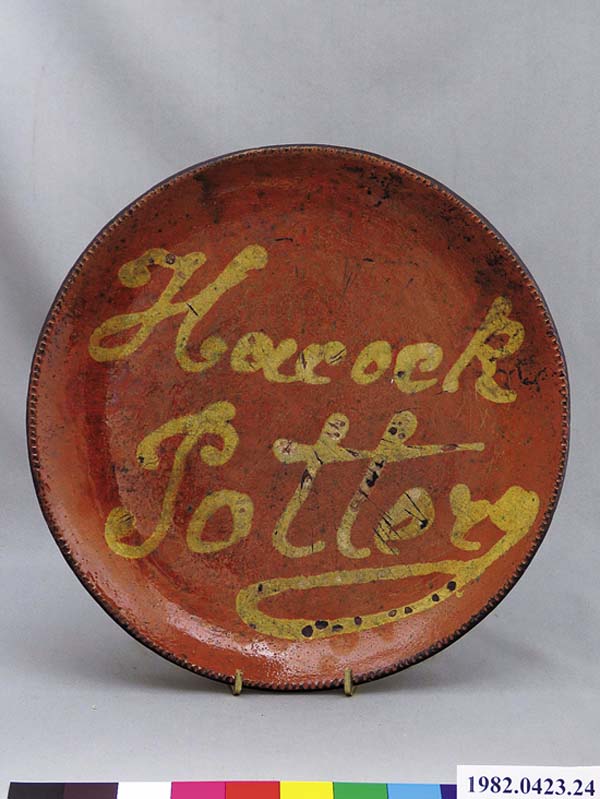
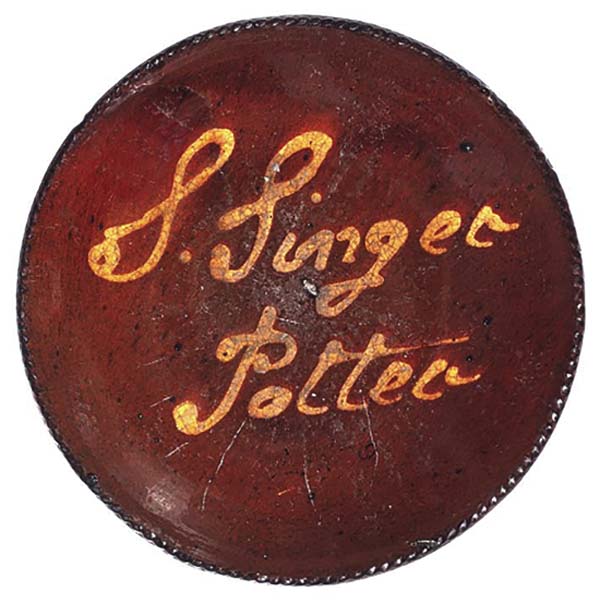
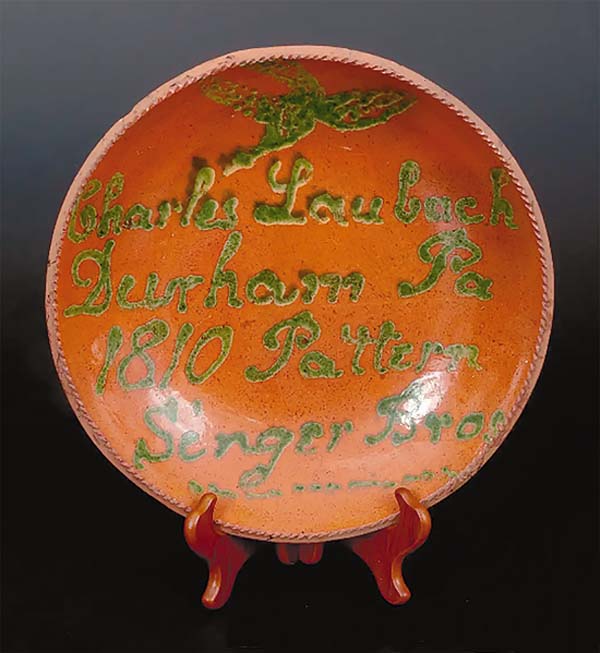
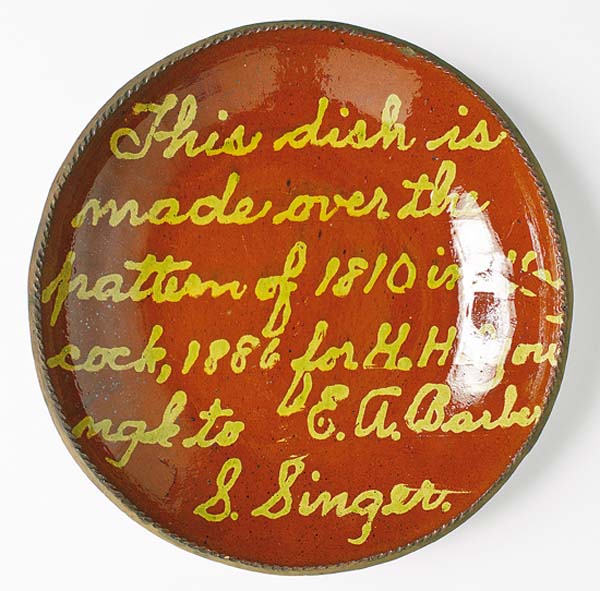
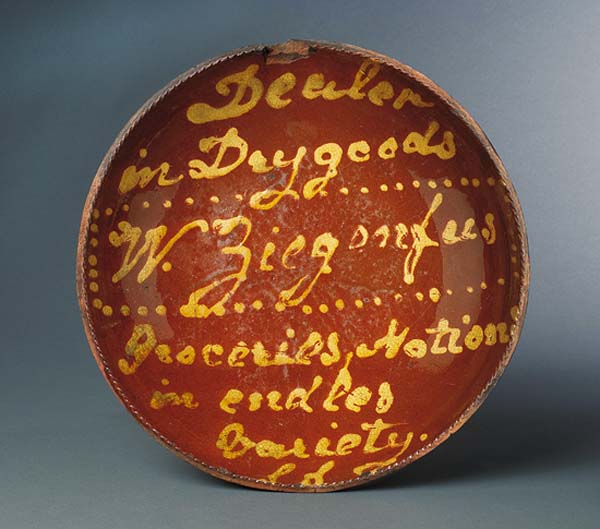
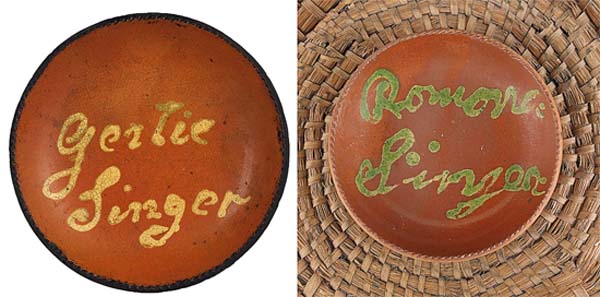
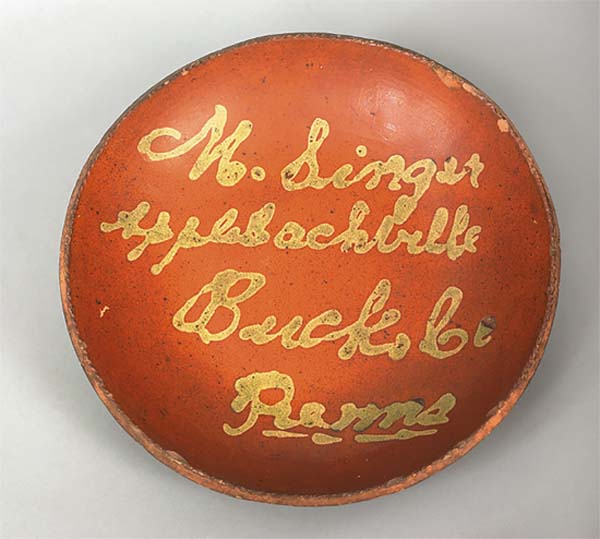
Unlike some of New England and parts of New York State, much of Pennsylvanias red earthenware tradition thrived post-1850 and following the Civil War. This was largely thanks to a number of migrant families who passed the tradition from one family member to the next, such as the Bell family in Waynesboro, the Bach family in Allentown, the Dry family in Berks County and the Miller family in Adams County. There was also 20th-century production by the Stahl family and Jacob Medinger (1856-1932) in southeastern Pennsylvania. However, another significant business was established by Conrad Mumbauer (1761-1845), a German in Haycock Township, Bucks County, Pa., a small community established in 1763, located about 52 miles north of Philadelphia and close to the New Jersey border. Mumbauer is well-known today for sgraffito decorated red earthenware, as well as other objects; he married Phoebe Ditlow (1763-1851) about 1786, and a son-in-law, John Mondeau (1808-1862), took over the pottery operations about the time of Mumbauers death in 1845. Mondeau married Phoebe Mumbauer (1816-1899) on Oct. 26, 1834. He was cited in tax records in 1834 and 1835 with an occupation of potter. Mondeau is cited in tax records after 1835 as owning horses, cattle and a large amount of land, including 112 acres that he purchased from Conrad Mumbauer on May 3, 1845. But Mondeau is not listed in any census with a primary occupation of potter. He seems to have lived a farmer-potter lifestyle, likely producing red earthenware as a secondary household income. There are conflicting reports as to when the pottery changed hands, but it seems that after Mondeau died in 1862, the pottery business was rebuilt and enlarged by Simon Singer (1822-1894). A migrant potter born in Baden-Wrttemberg, Germany, in 1822, Singer arrived in New York City on Sept. 4, 1846. He married Rebecca Herstine (1830-1900) in Bucks County on June 27, 1848, and the 1850 and 1860 United States Federal Censuses list him with an occupation of potter in Nockamixon Township, Bucks County, which was located about nine miles northeast of Haycock Township. Prior to Singers arrival, potters likeChristian Klinker (d. 1798)andPhilip Klineworked in the area, producing distinctive red earthenware objects, often adorned with sgraffito. Singers Civil War draft registration record from June 1863 does not cite where he lived, which included the fifth Congressional District, consisting of the counties of Bucks and the City of Philadelphia under the direction of Captain Mahlon Yardley (1824-1873). But the 1870 United States Federal Census lists him as a potter in Haycock Township. He is then listed as a potter in the 1880 United States Federal Census in Applebachsville, which is a village in northwestern Haycock Township, founded by General Paul Applebach (1815-1872) and his brother, Henry Applebach (1818-1865), in 1848. A son, Milton Singer (1855-1912), is documented by the Historical Society of Bucks County as being a potter, although he is listed in census records with a primary occupation of farmer. It was noted in a publication from 1897, titled Tools of the Nation Maker: A Descriptive Catalogue of Objects in the Museum of the Historical Society of Bucks County, Penna., that the historical society owns a slip cup from Milton Singer used for various yellow and green decorations. The Philadelphia Museum of Art also owns a slip cup that they described as having probably been used by Simon Singer. The historical society published, A Collection of Papers Read Before the Bucks County Historical Society: Volume 7, in 1937, where it was stated, Milton Singer operated the pottery until 1900 when all operations were discontinued. Webster Singer (1883-1953), son of Milton Singer, also worked in the pottery, but never learned the turners art. Another of Simons sons, Edward Singer (1850-1909), was cited with an occupation of potter in the 1880 United States Federal Census in Haycock Township and as a laborer in the 1900 Census in Haycock Township. Perhaps the most significant example of Edwards production known today is a three-color slip decorated red earthenware match box signed and dated several times E.S. / 1895. Other sons may have also been involved with the family pottery business, although it is unclear by searching census records, seeing that no other family members are cited with the profession of potter, but some are described as farm laborers. Those children include Cornelius (1852-1931), William (1859-1940) and Victor (1871-1940). Among the most significant examples of surviving red earthenware known from the Singer family today is a wide selection of slip-script and slip-decorated advertising plates, such as a dish with a Masonic symbol in the collection of Winterthur Museum in Delaware, inscribed, S. Singer/ Potter/ Applebachville/ Bucks Co/ Pa. An example of slip-script pottery from the Singer family was displayed a few years ago at the Landis Valley Village & Farm Museum in Lancaster, Pa., which was inscribed, J.M. Shaw / House Painter / Paper-Hanger etc. / Quakertown / Bucks County / Penn. According to the museum, James M. Shaw (1836-1902) was a paper-hanger and painter until his death, living in Quakertown, Pa. Crocker Farm also sold a slip-script plate on July 19, 2014, inscribed, Charles Laubach / Durham PA / 1810 Pattern / Singer Bros. A related plate with the same inscription sold at Christies in New York City as part of the John Gordon collection in 1999. Furthermore, in the spring of 2023, Crocker Farm sold a plate inscribed Victor Singer, likely representing the son of the potter Simon Singer who was born in 1871; the plate had previously sold in New York City. There are additional plates known with the inscriptions Gertie Singer and Romana Singer. Gertrud (b. 1873) and Ramona (1862-1934) were two of Simons daughters. The Philadelphia Museum of Art also owns a slip-script plate that was made in 1886 by Simon Singer for author and museum curator Edwin Atlee Barber (1851-1916), inscribed, This dish is made over the pattern of 1810 in Haycock, 1886 for H. H. Youngk to E. A. Barber S. Singer. Nonetheless, the significance of the Singer familys production in Pennsylvania is evident, although there has been some speculation about a 19th-century slip-script plate in the collection of the National Museum of American History at the Smithsonian Institution in Washington, D.C. The plate is inscribed Hancock Pottery. There is a Hancock, Berks County, Pa., but the hand that applied the slip does appear similar to some of the script applied by the Singer family. It was suggested during a museum appraisal in 1981 by New York City ceramic specialists Garrison and Diana Stradling that the Singer Pottery may have been the origin, but the museum curators at the time crossed that out on the cataloging sheet. There are also related pieces known, including a plate that reads, Hancock for Ever! Sources: Thomas, Justin W. The Bell Pottery Collection at the Renfrew Museum in Waynesboro, Pa. Antiques & Auction News, December 7, 2018. _____. Christian Klinker: A Pioneer German Potter From Bucks County, Pa. Antiques & Auction News, May 27, 2022. _____. A Collection Of Pottery That Descended In The Bach Family Of Allentown, Pa. Antiques & Auction News, July 26, 2024. ____. The 19th- And 20th-Century Stahl Family Pottery In Lehigh County, Pa. Antiques & Auction News, September 6, 2024. _____. The Dry Family Pottery Of Stoney Brook And Dryville: A Look At Berks County, Pa., Redware, Ca. 1806-80. Antiques & Auction News, June 20, 2025 _____. Miller Red Earthenware: A History Of The Familys Production In Adams County, Pa. Antiques & Auction News, July 11, 2025.

Share & Print






SHARE
PRINT